


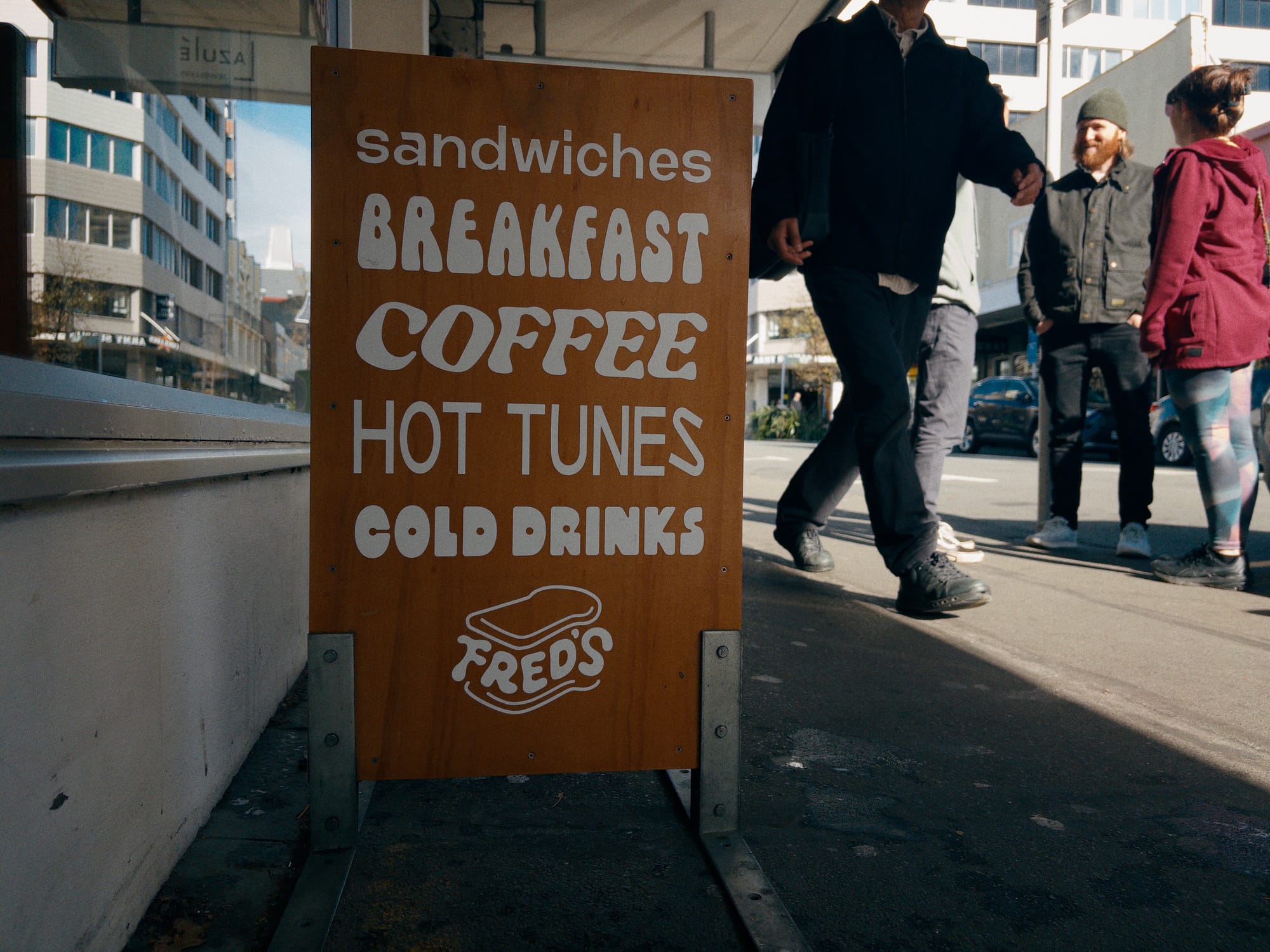
Fred’s Sandwiches on Cuba Street is so popular, people have to wait outside for their order.
Walk down Cuba Street and you’ll see that they are contributing to the liveliness of the street. People flock there, even on a bitterly cold lunch day, to enjoy a chicken sandwich or meet with friends.
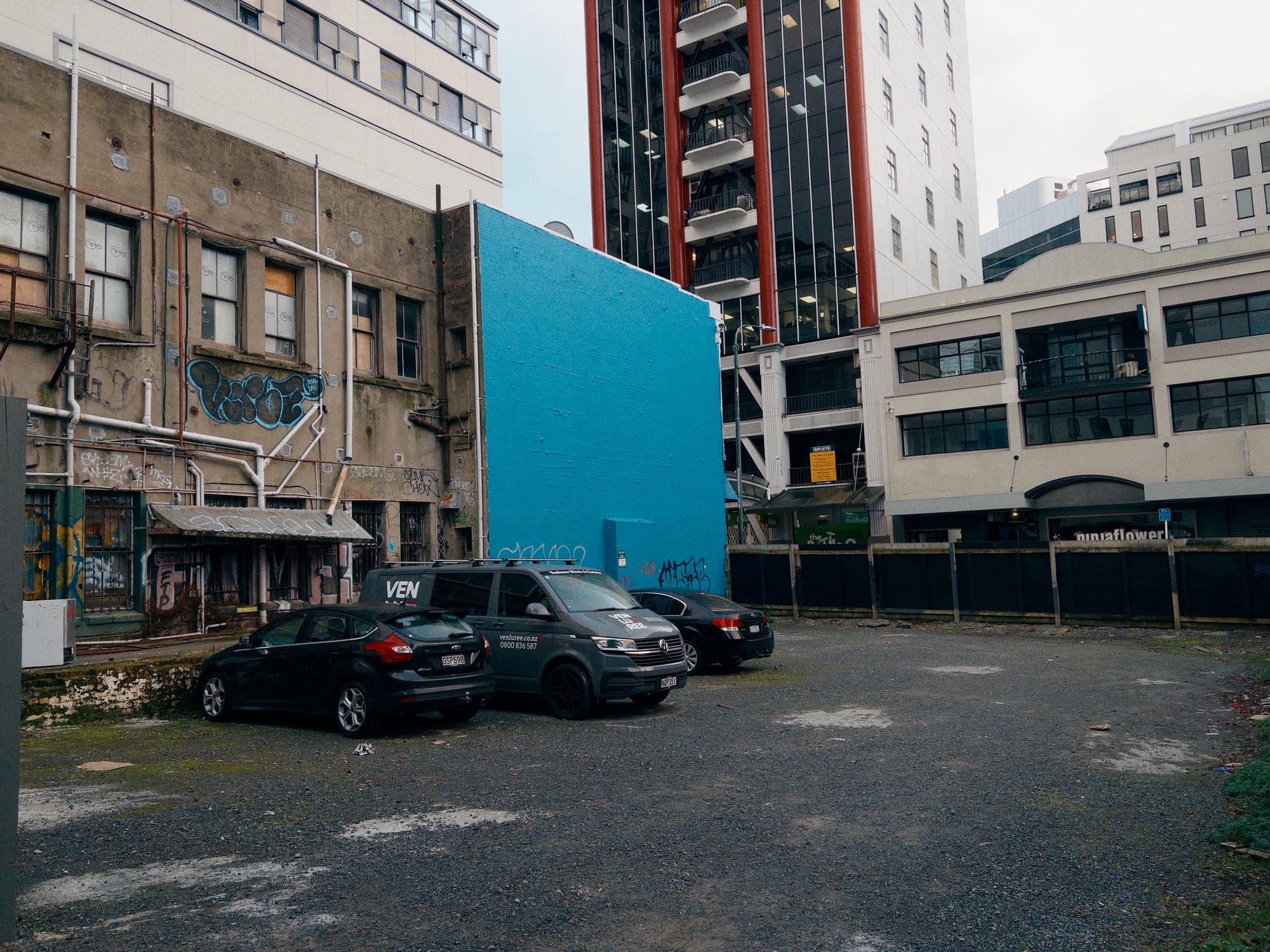
Ten metres down the road is an empty lot, used for car parking on the most pedestrian friendly street in town. In the middle of Central Wellington, 153 Cuba Street is an empty lot disguised as a car park.
The land is worth shitloads because Fred’s and other Cuba Street businesses are working their asses off to make our city cool.
And yet, actual buildings on Cuba Street pay higher rates per square metre than their wasted space neighbour nearby. (151 Cuba Street pays $104 per square metre. The carpark? $44.)
Imagine if local government prioritised community improvement over landowners leeching value. If empty lots went from car parks to courtyard apartments, and your landlord wasn’t penalised for insulating your flat.
The Council could make this vision a reality – just last month, the Council voted to ask Wellingtonians about a rating system that would unlock a thriving Wellington. It would help us cut climate changing pollution, help with housing affordability, and treat land value as the community resource it really is.
Why is land valuable?
Wellington City’s land is only valuable because of the community that resides on it: the workers attracting customers, the public spaces the Council builds and maintains, the artists that add murals and concerts. Take that same plot of land and put it in the middle of nowhere, and it’s worth nearly nothing.
Land value is created by community.
But right now, the value a community builds can be banked by people who contribute nearly nothing to their street.
Building and improving things in Wellington City is actively penalised, because rates are charged by the value of the building, not the value of the land.
An empty lot like the one by Courtenay Place or on Cuba Street fosters literally no community. But if quality apartments were built there, their rates would increase massively. The same goes for rentals: responsible landlords who fix up mouldy flats pay higher bills than slumlords.
Right now, landowners are effectively encouraged to suck the life from a community rather than invest in it.
Land is also one of the most serious and misunderstood parts of the climate change puzzle. Land is a limited resource, and what we do with it in everything from housing to food can make or break our climate change response.
If you use land poorly, more people are forced to drive to work and nature gets ripped up and turned into asphalt. If you use land well, by building up rather than out, low-carbon living becomes easier and more attractive. Plus, our climate-friendly forests and wetlands have room to exist.
We need to be building our cities up, rather than land banking lots in the middle of town. The more families we can offer quality housing to in our highly walkable Wellington City, the easier it is to drastically cut pollution and encourage low-carbon lifestyles.
There’s a way to flip the incentives to achieve this goal: it’s called a Land Value Rate.
Encouraging investment into our community
Instead of charging based on building, the Council is considering charging based on land. That means a gravel pit offering nothing to its community would have to pay the same rates as an apartment building next door providing homes and hospitality to hundreds.
Rates become cheaper for the people who are contributing, and more expensive for land bankers profiting off everyone’s effort to make somewhere cool.
Local organisations like Common Ground Aotearoa have been advocating for a switch like this for a few years. It’s clear to me why.
The community keeps more of the value it creates. Instead of a landbanker leeching profits off the workers, businesses, and council that makes their land valuable, they contribute to the maintenance and glow-up of our city.
It incentivises building in places where people want to be. It’s hard to justify sitting on a derelict parking lot when you could spread the rates across a hundred new apartments. In the central city, that means building up is better.
It encourages Council to invest in improving streets. If the Council upgrades Courtenay Place, they know their revenue will increase as land values increase. It aligns objectives: Council will know they will get more money by investing. There’s far fewer reasons to underfund street improvements.
Advocates for better cities have been rallying for taxing land rather than buildings, like in Washington State, which climate journalist David Roberts recently covered on Volts. Common Ground Aotearoa argues that 60% of Wellingtonians would be better off under land value rates.
The climate benefits are clear: taxing land value encourages building where people want to be, rather than at the edge of the city where they must burn fossil fuels to get places.
And importantly, the community gets to reap the benefits of their hard work. People make the place: land bankers shouldn’t reap the wealth we collectively sow.

What comes next
Wellington City is the region’s economic engine. It needs people and communities to invest in it so our city can keep thriving.
Politicians have made progress: the last Council under Tory Whanau unlocked huge capacity for building tight-knit apartments and townhouses across Wellington City.
The next action to make housing more affordable is clear. Discourage landowners from land banking the increased value. Use rates to encourage construction on valuable land.
Redesigning our rates system to better use those sordid lots across Wellington is not a guarantee, though.
Some councillors hate the idea. Take, for example, this interaction between Nicola Young and Pierson Palmer from Common Ground Aotearoa:
[Young] countered that - when the city had used LVR ahead of 1992 - some developers had put up cheap structures "the curse of which we are still living with today".
"Have you seen how grotty the Oaks [complex on Cuba Street] is?" Young asked Palmer.
"Have you seen how grotty the empty lots are?" countered Palmer.
It’s all up for grabs. There are no guarantees that this will happen, especially considering the Council has been working on a land value rate for nearly three years already.
If we want a thriving, growing city centre, a land value rate is a real option for encouraging it. Rather than wandering past a derelict lot to get to Fred’s Sandwiches, you might walk past a thriving shop or courtyard apartments.